
Crypto's Role in an Investment Portfolio

Adding Crypto (using Bitcoin as a Proxy) contributed positively to a diversified portfolio’s returns in 74% of one-year periods, 93% of two-year periods, and 100% of three-year periods since 2014, assuming quarterly rebalancing.
Through the first nine months of 2025, Bitcoin ETFs have pulled in USD 22.5 billion, putting them on pace to end the year with about USD 30 Billion in flows. This is just one measure indicating that the crypto asset class is transitioning from the margins into the mainstream.
Case in Point: The largest wealth managers in the world have been prohibited from buying bitcoin ETFs. That is changing, fast. On 1 October 2025, Morgan Stanley's Global Investment Committee, which guides 16 000 advisors managing USD 2 Trillion, published a report titled “Asset Allocation Considerations for Cryptocurrency.” The landmark report states that financial advisors and clients at the firm may now “flexibly allocate to cryptocurrency as part of their multi-asset portfolio.” It suggests allocations up to 4% can be appropriate for risk-tolerant investors.
Similarly, Bitwise Asset Management, a global crypto asset manager with more than USD 15 Billion in Assets Under Management and a suite of over 30 crypto investment products spanning ETFs, separately managed accounts, private funds, hedge fund strategies, and staking, published a report titled "Bitcoin's Role in a Traditional Portfolio"
A snapshot of the Insights:
- "Adding a 2.5% bitcoin allocation with quarterly rebalancing would have improved the cumulative return of the portfolio to 148.09%. This would have been achieved without major changes in either the portfolio’s volatility (8.89% with bitcoin versus 8.49% without) or its maximum drawdown (23.72% with bitcoin compared to 22.07% without). The portfolio’s Sharpe ratio, which measures excess returns per unit of risk (measured as standard deviation), would have improved by 55%."
- "A 5% allocation to bitcoin would have boosted the cumulative return of the portfolio to 210.63%, more than doubling the total return of the traditional portfolio."
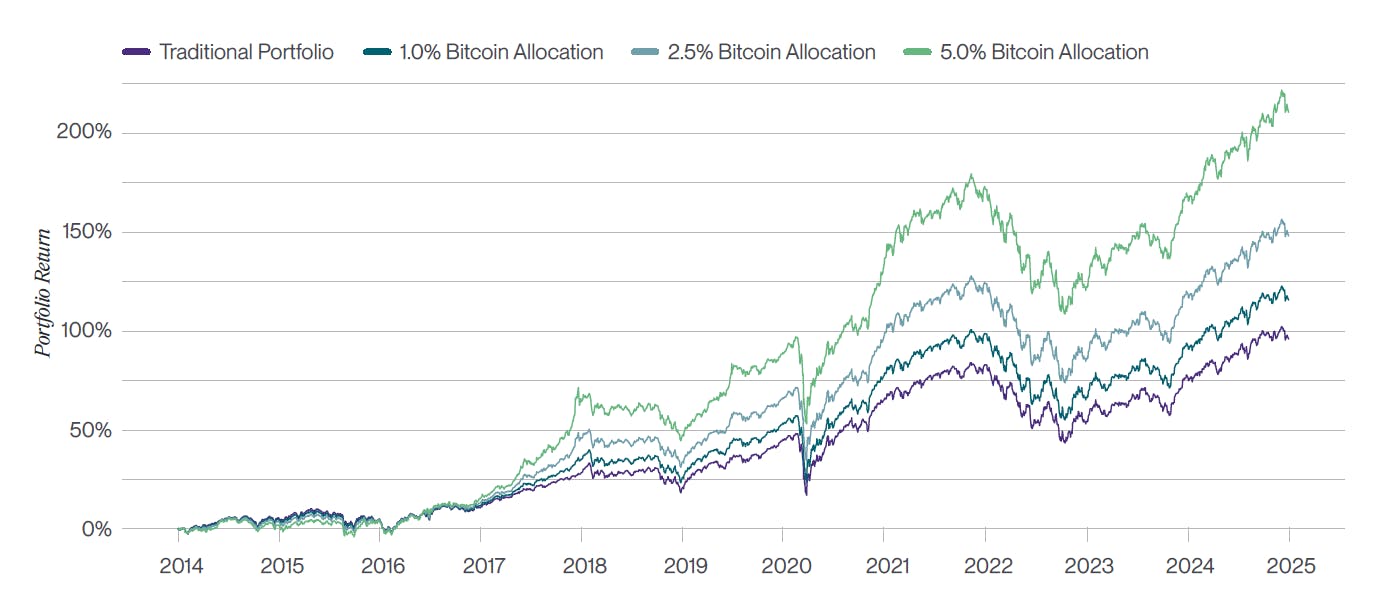
Figure 1: Traditional Portfolio With and Without Quarterly Rebalanced Bitcoin Allocations
- "Small allocations to Bitcoin have a minimal impact on portfolio volatility because Bitcoin’s returns are not typically correlated with stocks or bonds, which can blunt the impact of overall volatility."
- "Maximum drawdowns are perhaps the foremost factor for investors to consider when deciding how much bitcoin to add to their portfolio. Over three-year holding periods, adding larger and larger allocations to bitcoin would have monotonically increased a diversified portfolio’s cumulative returns. But our study showed that the impact on Sharpe ratios generally started to level off at the 5% allocation level. We also found that the impact on maximum drawdowns began to increase rapidly at allocations of 5% or more. This may make it uncomfortable for investors to allocate above this level."